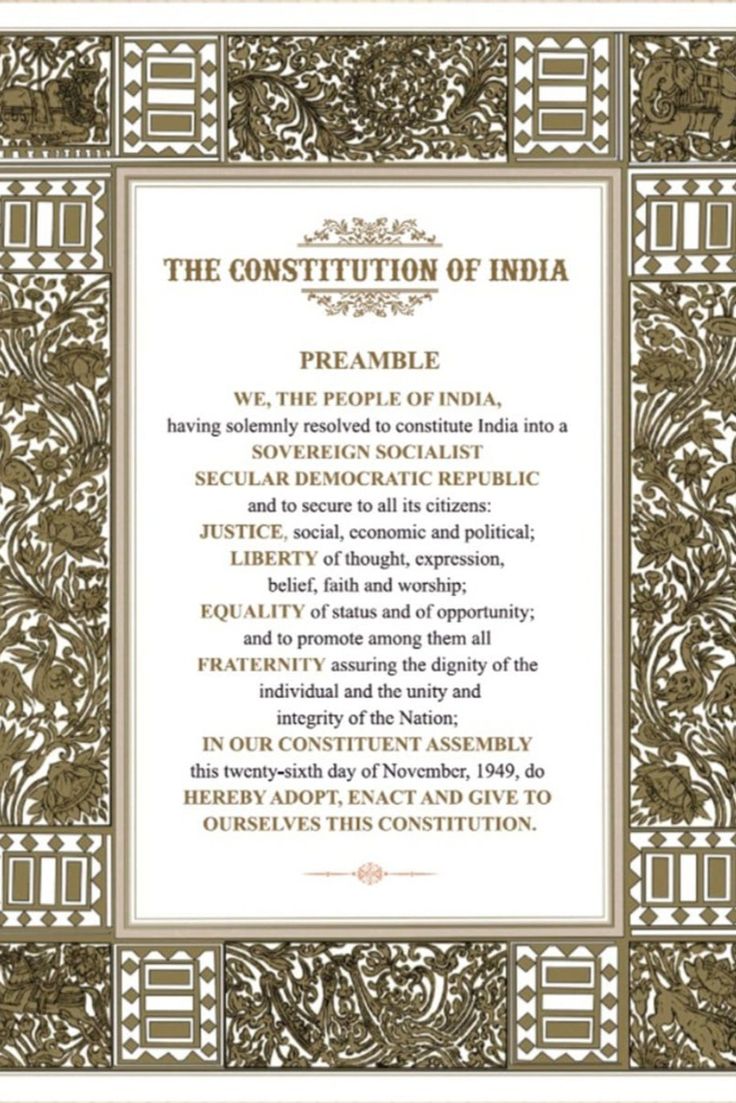


Preamble to the Indian Constitution: Meaning, History, Features & Importance
Introduction
The Preamble to the Indian Constitution is often described as the “identity card” of the Constitution. It reflects the philosophy, ideals, and objectives that guide the nation. Serving as the introductory statement of the Constitution, the Preamble highlights the vision of the Constitution-makers and the fundamental values on which India stands.
What is a Preamble?
A Preamble is an introductory statement placed at the beginning of a legal document or Constitution. It explains the purpose, guiding principles, and objectives of that document.
In the context of the Indian Constitution, the Preamble outlines:
- The source of authority of the Constitution
- The nature of the Indian State
- The objectives to be achieved
- The date of adoption of the Constitution
It acts as a guiding framework for understanding the spirit and philosophy of the Constitution.
History of the Preamble
The foundation of the Preamble was laid through the Objectives Resolution moved by Jawaharlal Nehru in the Constituent Assembly. This resolution was adopted on 22 January 1947 and later became the basis of the Preamble.
Although the Preamble is not directly enforceable in courts, it plays an important role in interpreting constitutional provisions whenever ambiguity arises.
Components of the Preamble
The Preamble highlights four major aspects:
1. Source of Authority
It begins with the phrase “We, the People of India”, signifying that the Constitution derives its authority from the citizens of India.
2. Nature of the Indian State
India is declared to be:
- Sovereign
- Socialist
- Secular
- Democratic
- Republic
3. Objectives of the Constitution
The Constitution aims to secure:
- Justice
- Liberty
- Equality
- Fraternity
for all citizens.
4. Date of Adoption
The Constitution was adopted on 26 November 1949.
Key Terms in the Preamble
We, the People of India
This phrase establishes that the ultimate power lies with the people of India. It reflects popular sovereignty.
Sovereign
India is independent and free from external control. The country has the authority to make its own laws and policies.
Socialist
The term reflects the goal of reducing inequality and ensuring social and economic justice through democratic means and a mixed economy.
This word was added through the 42nd Constitutional Amendment Act, 1976.
Secular
India treats all religions equally and provides equal respect and protection to every faith.
The term was added to the Preamble through the 42nd Amendment Act, 1976.
Democratic
India follows a democratic system where the government derives its authority from the will of the people expressed through elections.
Republic
The head of the State, i.e., the President of India, is elected rather than inheriting the position through monarchy.
Objectives of the Indian Constitution
The Constitution aims to maintain harmony, integrity, and unity in the country. Its primary objectives are reflected through the following ideals:
Justice
Justice ensures fairness in society and is achieved through Fundamental Rights and Directive Principles of State Policy.
It includes:
- Social Justice: Elimination of discrimination based on caste, religion, gender, race, or creed.
- Economic Justice: Equal opportunities for all and prevention of discrimination based on wealth or economic status.
- Political Justice: Equal political rights and opportunities for every citizen without discrimination.
Equality
Equality means that every individual is equal before the law and no citizen enjoys special privileges.
The Constitution guarantees equal opportunities for all citizens.
Liberty
Liberty provides freedom of thought, expression, belief, faith, and worship. However, liberty is subject to reasonable restrictions imposed by law.
Fraternity
Fraternity promotes brotherhood, dignity, national unity, and emotional integration among citizens.
The ideals of liberty, equality, and fraternity are interdependent and essential for building a balanced and democratic society.
Importance of the Preamble
The Preamble acts as:
- A guiding principle for governance
- A source for understanding constitutional values
- A tool for interpreting constitutional provisions
- A statement of national ideals and aspirations
It reflects the vision of creating a just, equal, and united India.
Status of the Preamble
The constitutional status of the Preamble has been clarified through important Supreme Court judgments.
Berubari Case (1960)
In the Berubari Union case, the Supreme Court held that:
- The Preamble is not a part of the Constitution
- It can help in understanding the intentions of the Constitution-makers
- It is not enforceable in a court of law
Kesavananda Bharati Case (1973)
In this landmark judgment, the Supreme Court reversed its earlier view and declared that:
- The Preamble is a part of the Constitution
- It plays an important role in constitutional interpretation
- Its basic structure cannot be destroyed through amendments
This case established the famous Basic Structure Doctrine.
Union Government vs LIC of India (1995)
The Supreme Court again reaffirmed that the Preamble is an integral part of the Constitution, though it is not directly enforceable in courts.
Amendment of the Preamble
The Preamble has been amended only once through the 42nd Constitutional Amendment Act, 1976.
The following changes were made:
- The words “Socialist” and “Secular” were added
- The phrase “Unity of the Nation” was changed to “Unity and Integrity of the Nation”
The amendment was made under Article 368, which gives Parliament the power to amend the Constitution.
However, the basic structure of the Preamble cannot be altered.
Important Facts About the Preamble
- Article 394 states that some provisions of the Constitution came into force on 26 November 1949, while the remaining provisions came into effect on 26 January 1950.
- The ideals of Liberty, Equality, and Fraternity were inspired by the slogan of the French Revolution.
Conclusion
The Preamble is the soul of the Indian Constitution. It reflects the aspirations of the people and the vision of the Constitution-makers for an inclusive, democratic, and progressive India.
Though not enforceable by courts, it serves as a guiding light for governance, law-making, and constitutional interpretation. The values enshrined in the Preamble continue to shape the identity and democratic spirit of India.